
Why did Lam Son 719 fail?
While it is difficult to pinpoint a singular reason behind the failure of operation Lam Son, Hue and Danziger each demonstrate three core components behind its failure: dysfunction and political meddling in the military command; desertion and insubordination; and the lack of tactical experience combined with the inaccessibility of air support.
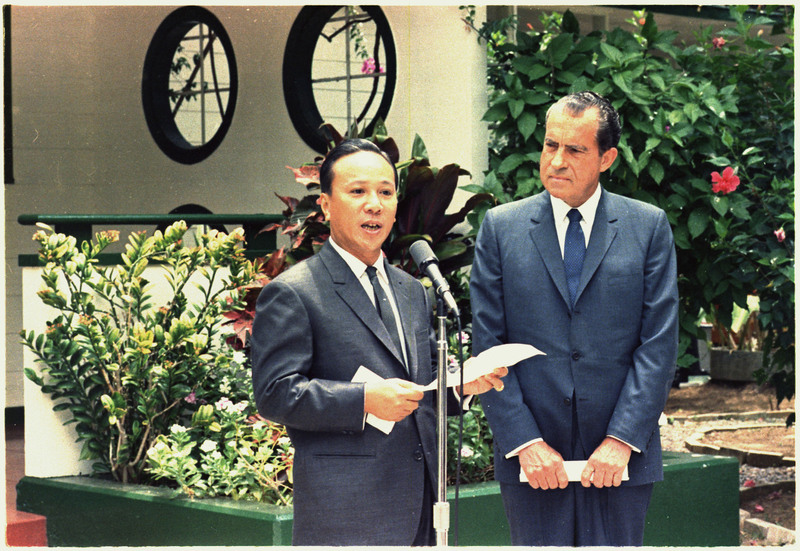
Nguyen Van Thieu meeting with President Richard Nixon on Midway Island, June 8, 1969
President Nguyen Van Thieu, who was worried that a loss could tank his political standing and credibility, intervened multiple times during the operation. He and General Hoang Xuan Lam, the commander of the forces conducting the operation, both saw the operation as a matter of national pride and were intent on salvaging South Vietnam’s reputation. Instead of withdrawing, they ordered the 1st Division to capture Tchepone despite beliefs among the high command that the village had become a symbolic target. In fact, many correctly surmised that the PAVN had moved its supply caches out of the town and that the PAVN were waiting around the village to trap the ARVN forces. Consequently, Hue’s 2/2 and other regiments that helped to capture Tchepone were ripped to shreds once the PAVN sprung its trap, leading to thousands of casualties.
Dysfunction was also widespread in military command. Simple orders—such as when General Lam ordered an idle ARVN armored brigade to reinforce the surrounded Firebase 31—had difficulties making their way through the dysfunctional ARVN command system. The armored unit, which was under the control of Lieutenant General Du Quoc Dong, took a great deal of time to set out for the firebase as General Dong’s personal feud with Lam got in the way. This enabled the PAVN to catch wind of the reinforcement and ambush the brigade during their journey to the firebase, destroying two tanks. Although Lam had ordered the armor to continue the relief effort, Dong ordered the armor to stay put, allowing the firebase to be slaughtered.
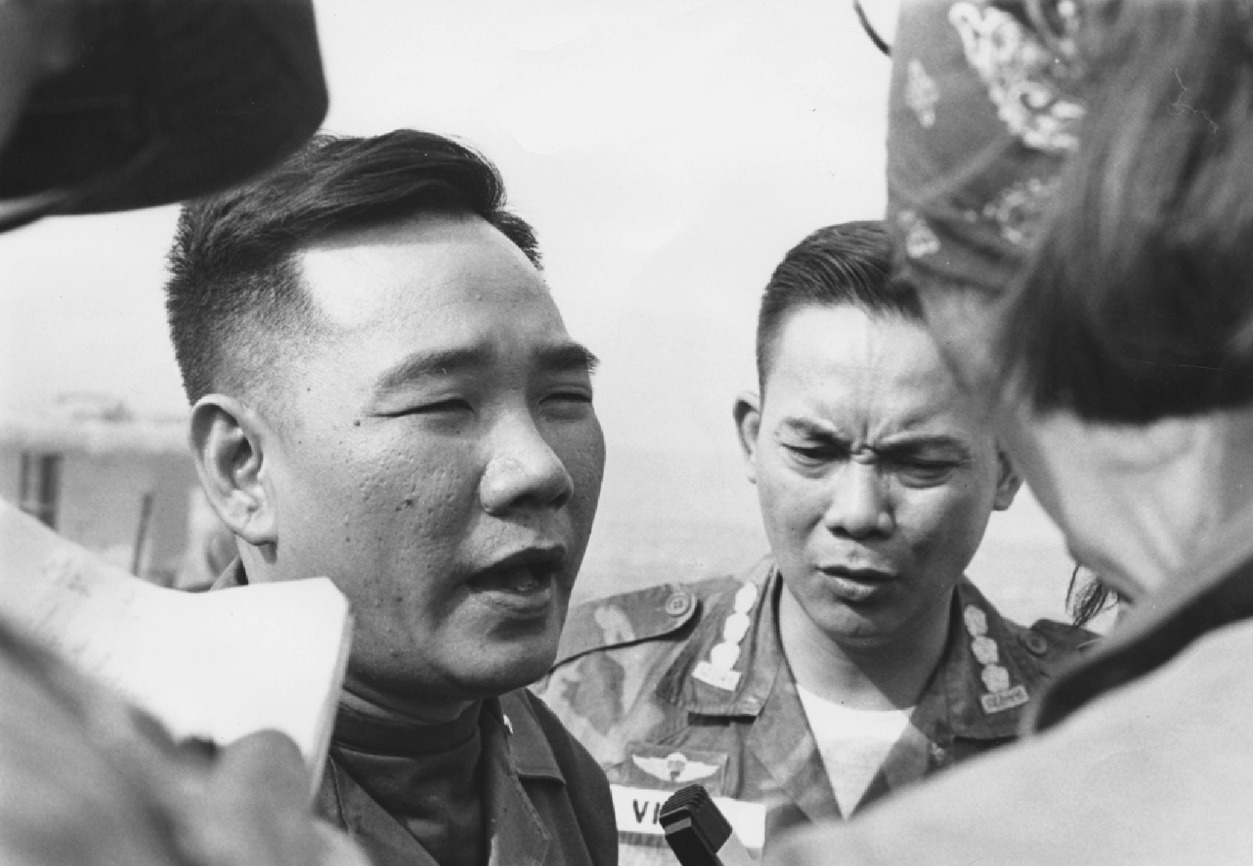
General Lam giving news on Lam Son 719 to the press, 1971
It became very apparent that insubordination was widespread among the ARVN during the operation. According to ARVN Major General Nguyen Duy Hinh, “During the operation, there were several instances in which division commanders lost control of their units. Even the 1 Corps commander [Lam] sometimes did not know the major events affecting his divisions.” From interpreters to grunts, ARVN soldiers refused to fight, resulting in holes in the attack. This led to undermanned regiments which were no match for the swelling numbers of PAVN in the region. A shortage of Forward Air Controllers (FACs) contributed to a lack of air support, which left many units—including Hue’s—on their own. It also exacerbated logistical challenges, as commanders had difficulty coordinating troop movements and operations with many units AWOL.
Finally, the absence of American advisors left the ARVN ill-equipped to fight Operation Lam Son on their own. The ARVN—who had for years served as an auxiliary to the American forces—had grown overly dependent on American expertise and firepower. This left them inexperienced in the tactics of battle and unwilling to conduct probes, strategically maneuver themselves, or attack the enemy when engaged by PAVN forces. Tactical maneuverings, which were usually organized by the advisor, were cast aside by ARVN units as they opted to stay put and wait for air support.
However, air support was ineffective due to the inability of advisors to accompany the ARVN into Laos. According to Colonel Benjamin Harrison, a senior adviser to the 1st ARVN division, “The ARVN could scream and cry, but by not having their advisers with them they could not transmit the true nature of the situation across to the Air Force as well as their adviser would have… [In situations which] normally a U.S. adviser would have raised all kinds of hell… [the ARVN often could not get their point across and] got their asses shot off by the NVA and couldn’t get any tactical air support.” In Hue’s words, “The high command trust in my advisor more than me.” A lack of training in these areas, in addition to the lack of air support, promoted indecision among the ARVN ranks. This led many ARVN units to unnecessarily hold dangerous positions and allow the PAVN to encircle them, in the hopes that air support would solve everything—only for the air support to never arrive. Meanwhile, the American advisors could only sit and watch helplessly as their ARVN colleagues slowly succumbed to a growing swarm of PAVN forces.
So, was the failure of Lam Son 719 inevitable? The answer is complicated. It took a perfect storm (and a few literal storms) of bad decisions, corruption, and various other factors to allow the PAVN to reverse the ARVN’s early gains and trap the ARVN forces.
What is certain is that, despite Nixon’s declaration that “Vietnamization has succeeded” after Operation Lam Son 719 concluded, the total failure of the South Vietnamese military to fight without American assistance marked the end of any hope that Vietnamization could lead to a self-sufficient South Vietnamese military. Ultimately, the reasons why Lam Son 719 failed were reflected in the swift capitulation of South Vietnam once the U.S. fully exited the country.