
Protest Actions on the Faculty Front: Civil Disobedience & Dissent in Court
Organizing civil disobedience in Lebanon, NH
As the Vietnam War churned on in the spring of 1972, Dartmouth’s antiwar faculty frequently planned protests in Lebanon, New Hampshire to block the transit of buses for military recruitment. In organizing these acts of civil disobedience, the faculty embraced the stakes of their dissent on their own accord.

Photo in The Dartmouth capturing anti-war demonstrations in Lebanon blocking a draft bus. 1972.
For example, in her 2025 oral history, Professor Carolyn Eisenberg explains how she and other faculty made a “decision [they] were going to get arrested, and it was also a decision not to have students get arrested with [them]. That [would feel] really irresponsible.”
Students eventually did involve themselves in the Lebanon protests of ‘72; on May 16, fifteen faculty and nine students found themselves under arrest by New Hampshire state troopers. Nevertheless, the faculty’s explicitly self-organized plans for protest suggest that they too were a core of antiwar civil disobedience, strengthened by but not contingent on student and community presence.
Bringing dissent to the court
Speeches
Even upon their arrests, the faculty did not cease to find opportunities to express their antiwar dissent. As faculty were summoned for trial in the Hanover state court, Professor Leo Spitzer observes a “pattern” of faculty members utilizing their speech time to express opposition to the war. Himself arrested in the fall of ‘72, Spitzer recounts his personal effort at bringing protest to the court:
Professor Spitzer’s description of trial speeches as a “pattern” and his emotionally infused memories of an “impassioned speech” reflects how for many faculty engaging in civil disobedience in 1972, arrest was not an obstacle to dissent but an opportunity for it. Professor Carolyn Eisenberg adds in her own oral history that “of course [they] were all fearful,” but “it’s just a thing to get arrested.”
Professional Connections
Faculty members also utilized their personal and professional connections to create powerful political moments in the courthouse. For example, Professor Carolyn Eisenberg recalls Professor Jonathan Mirsky’s well-publicized court case, where he took the opportunity to redirect claims of criminal action to the United States government.
Reach

Cartoon published in The Dartmouth of Associate Professor of Government David Baldwin pleading guilty in court for civil disobedience in Lebanon.
While these speeches seldom affected the outcome of faculty’s cases, they functionally transformed a supposedly apolitical courthouse into a platform for publicity of the antiwar cause. Their words became fuel for further dissent at Dartmouth, as rallies often drew from student and faculty testimonies in court. For example, during an April 17, 1972 anti-ROTC rally on the steps of Parkhurst Hall, a student recited the words of Professor Dona Strauss’ trial testimony to an over 150-person audience. Professor Strauss was on trial for her involvement in the 1969 Parkhurst Hall Occupation, where students and faculty seized Parkhurst Hall demanding the immediate abolition of the ROTC program. In protest of the courthouse’s disproportionate consideration for legal minutiae over politics, Professor Dona Strauss argued, “The overwhelming fact is the war in Vietnam. For all of us, the most important question was, what can we do to stop the war.”
“The overwhelming fact is the war in Vietnam. For all of us, the most important question was, what can we do to stop the war.”
— Professor of Dona Strauss
Reaching the halls of power
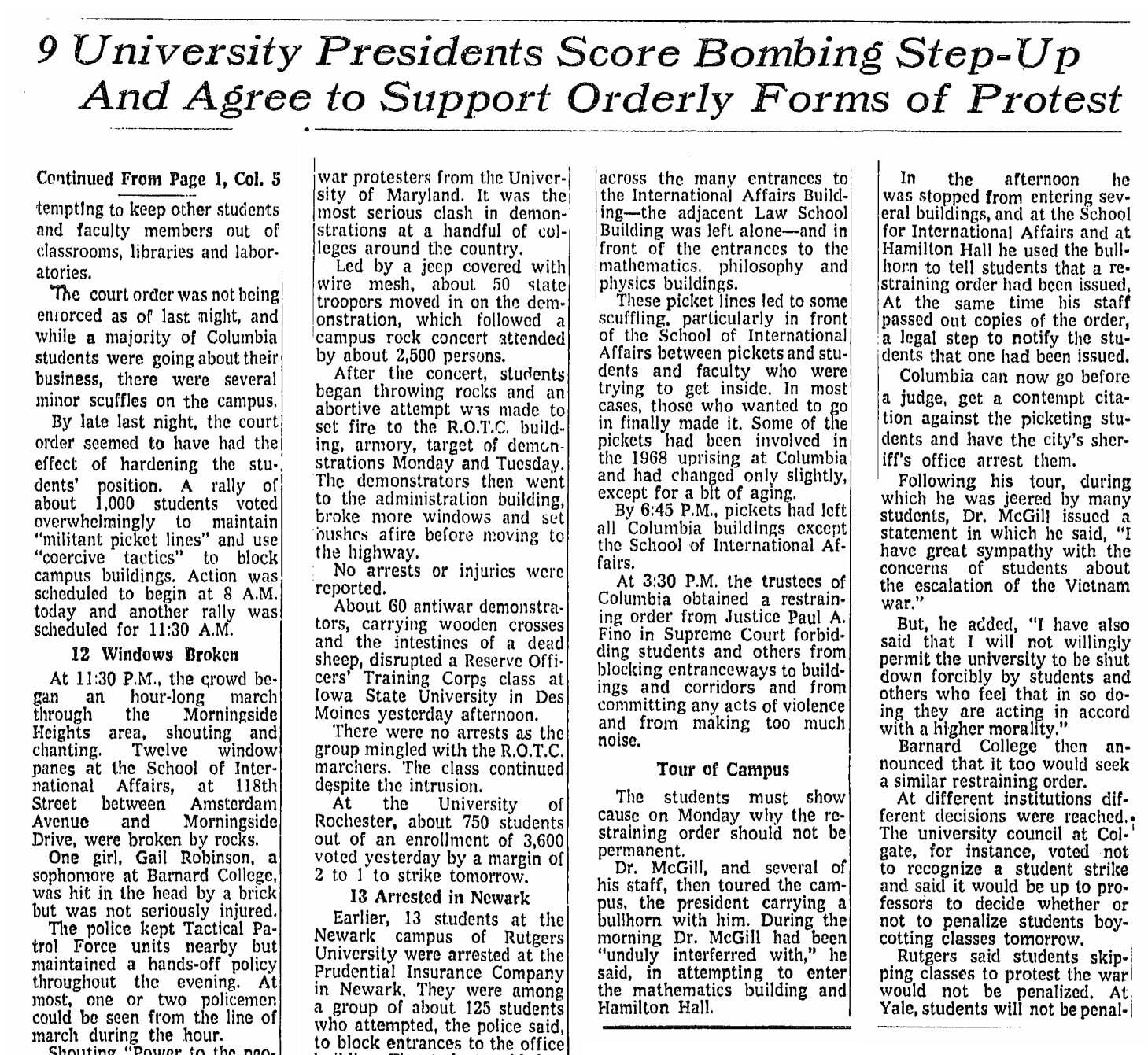
The NYT reports on the 9 college presidents collective message for President Richard Nixon to end the Vietnam War.
While to the cynical spectator, these protests might have appeared futile in the moment, Professor Eisenberg’s Fire and Rain: Nixon, Kissinger, and Wars in Southeast Asia uncovers how antiwar dissent at home directly contributed to Nixon’s urgency in negotiating an end to the war.
How did acts of civil disobedience at Dartmouth reach these halls of power? Waves of arrests in the spring and fall of 1972 certainly played a part. Faculty arrests were uniquely difficult for college administrations to ignore, as their absence entailed the cancellation of class sessions for dozens. Pressured by the disruptions these faculty caused, in April 1972, eight Ivy League presidents and the president of MIT visited National Security Advisor Henry Kissinger in the White House to demand an end to the Vietnam War. Their visit was preceded by a collective letter to President Nixon published in the New York Times “[deploring] the bombing of North Vietnam and its civilian population.”
With Nixon’s election upcoming in November, the college presidents’ White House visit and extensive lobbying efforts in Congress placed significant pressure on President Nixon to accelerate the withdrawal of troops. Congressional lobbying in particular factored significantly into his decision-making; the one thing Nixon could not afford to lose was Congressional appropriations for the war.
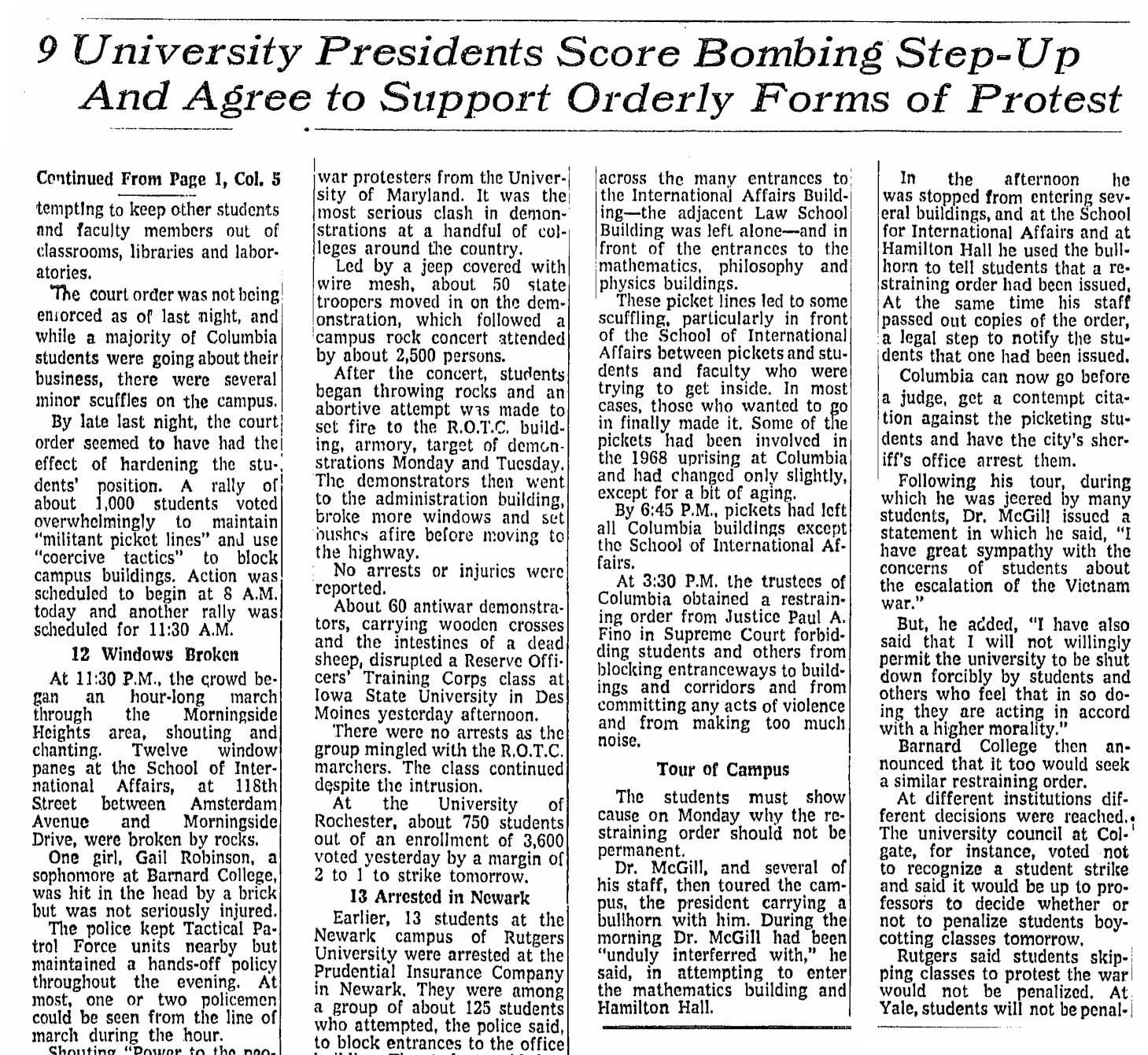
"9 University Presidents Score Bombing Step-Up and Agree to Support Orderly Forms of Protest"
The New York Times article reporting the college presidents' demand for President Richard Nixon to end the Vietnam War. April 20, 1972.

"38 Arrested in Lebanon Protest"
The Dartmouth article reporting on the 38 protesters arrested in Lebanon for blocking a draft bus. May 16, 1972.

"Eye Witness Report: Behind the Bars with The Leb '38"
The Dartmouth article reporting on "The Leb '38's" experience behind prison bars. May 16, 1872.