
Working from within: Administrative dealings for institutional change
During this period, professors possessed a significant amount of input into administrative decision making. According to Professor Marysa Navarro-Aranguren, Dartmouth was “enormously democratic. It was also an institution where the faculty had a great deal of power.” This power grew particularly relevant in late ‘60s, when the Executive Committee of Faculty was tasked with deliberating the fate of the ROTC program.
Notably, the faculty were not a homogeneous entity during this time; alongside Dartmouth’s subset of active antiwar professors was a significant portion of faculty standing against them. As Professor Gene Garthwaite recalls, the “English department, for example, was a bastion of conservatism. The economics department was, too.” As a result, outcomes of formal faculty meetings were often unsatisfactorily moderate, the awkward middle ground of starkly diverging political perspectives.

Two dozen faculty meet on May 9, 1972 to discuss the new developments of the Vietnam War.
Irrespective of these meetings’ particular outcomes, Dartmouth’s antiwar faculty relentlessly forced the group to reckon with the heart of the issue at hand: whether the College wanted to be complicit in one of the most violent acts of mass destruction in U.S. history.
Holding the line against ROTC
In 1968, the ROTC submitted a report to the Executive Committee concluding that while the ROTC’s presence could be reduced, it was “not necessarily incompatible with the purpose of liberal arts education” and conformed to the “public service function…of American higher education.” Promptly, in response, Professor Mirsky submitted a letter to the committee criticizing these arguments line-by-line.
These questions forced the faculty to consider the militaristic roots of the ROTC’s true intentions:
The internationalist that he was, Professor Mirsky contextualized his plea against the ROTC in the context of global events:

Physics professor Arthur Luehrmann proposes a faculty letter to alumni action against escalation of the Vietnam War to the general faculty in 1972.
His repeated exclamation marks, rhetorical questions, and intense descriptions of atrocity abroad reflect the sense of urgency he conveyed to the faculty that perhaps no archival text could do justice. Letters like these, written and aired at formal faculty meetings, provided a rare channel for the expression of antiwar dissent within institutionally sponsored forums.
While impossible to measure precisely the impact of faculty members' dissent in these meetings, Professor Gene Garthwaite playfully recalls how they “complicated” the proceedings for President John Sloan Dickey:
Reaching Abolition
Only two years later, in 1970, the Army and Air Force terminated their ROTC programs, followed by the Navy in 1972. During these years, select faculty continued to hold the line against piecemeal action in faculty meetings, while students led a relentless series of student rallies, fasts, sit-ins, and acts of civil disobedience. The 1969 student-led Parkhurst Occupation placed immense pressure on the College—not only to phase out the ROTC over time but immediately terminate the program. The journey towards ROTC abolition contained multiple layers of tactics—from the bravely protesting students on Parkhurst to the faculty who worked from within to amp up the pressure.
“Rather than offer our students (and ourselves) to that part of society which means only death, let us take the opportunity, which should be pleasant for us and a joy to our students, to reaffirm life.”
— Professor Jonathan Mirsky
To learn more about the history of the ROTC program at Dartmouth, including ROTC abolition and its later reinstatement, visit our DVP exhibit Duty, Honor, Resistance: The History of ROTC at Dartmouth from the Cold War Era to Today.
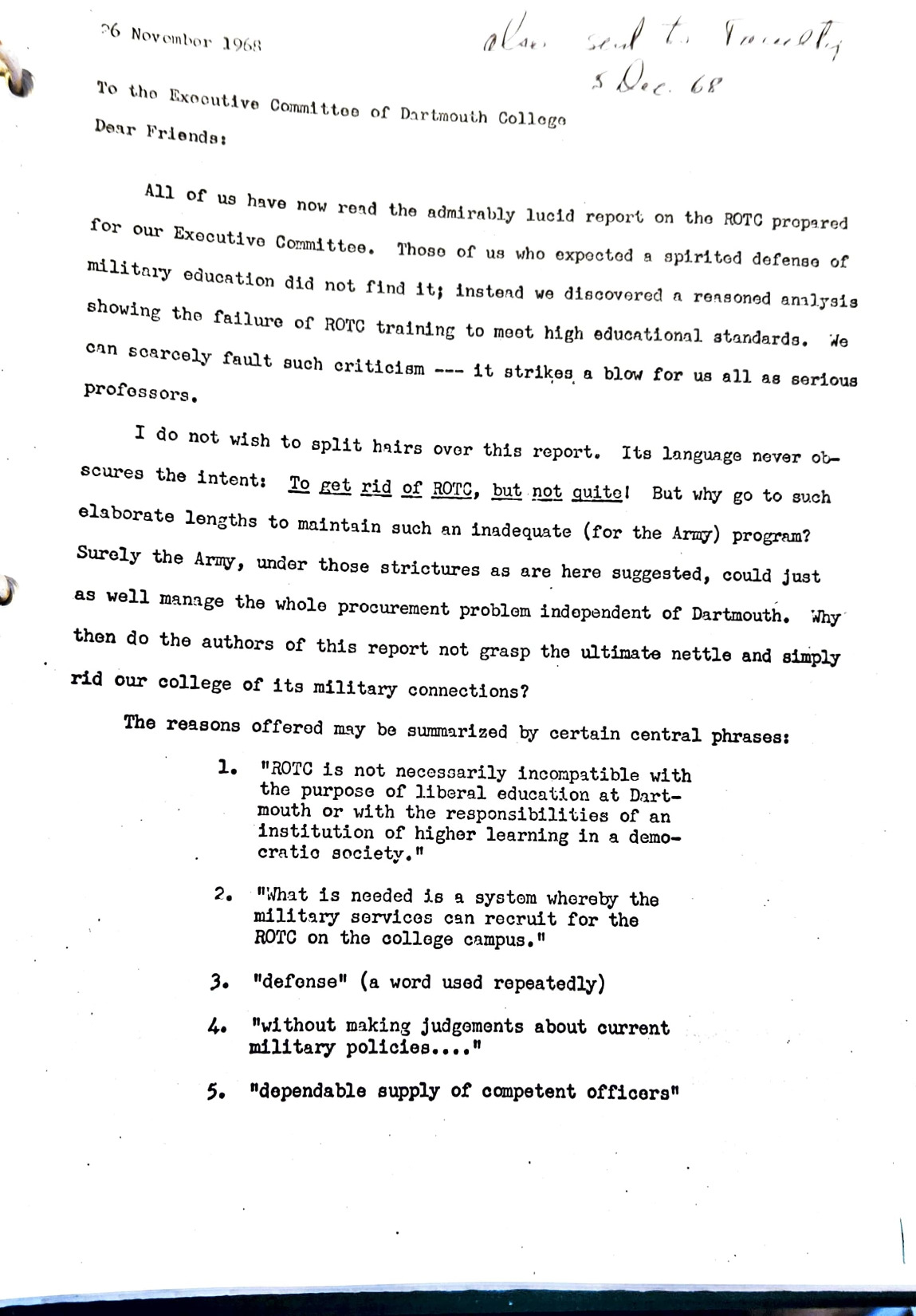
Letter to the Executive Committee by Professor Jonathan Mirsky
Letter to the Faculty by Professor Jonathan Mirsky responding to the ROTC's submitted report.

Letter to the Faculty by Professor John W. Lamperti
Letter to the Faculty by Professor John W. Lamperti demanding an end to the ROTC.