
Part of a whole: Faculty-student collaborations for antiwar dissent
Constant throughout the faculty’s varied participation in dissent was the students’ persistent and often inspirational presence alongside them. Indeed, many of the antiwar faculty during this period recalled harboring close and collaborative relationships with students, both within and outside the classroom context.
A Different Atmosphere
These relationships were backgrounded by the unique political and social atmosphere that defined late ‘60s and early ‘70s at Dartmouth College. Professor Garthwaite observes how “as a result of Vietnam and as a result of the civil rights movement in this country, younger faculty in particular—some of the older, established ones as well—interacted very closely with students in terms of political action.”
Interactions like these were not only the result of individually fruitful relationships, but a culture of conversation and discussion fostered by the History Department. Professor Marysa Navarro explains:
History students and faculty often socialized in the History Department’s floor on Reed Hall. Professor Eisenberg describes the one-time atmosphere:

Photograph of the Reed Hall interior, where students and faculty often gathered to socialize and discuss political matters.
Each of these professors speak of the culture of the history department in a nostalgic past tense, revealing how this atmosphere amongst faculty and students was extremely unique to the Vietnam War period.
For some professors, their relationships with students lasted far beyond their times at Dartmouth. For example, Professor Eisenberg is now currently working with Legacies of War, an organization that one of her students, John Cavanagh, helped found.
Protesting in concert
While much of faculty and students’ protests were planned independent of each other, they certainly did not consider themselves separate antiwar groups. As thoroughly demonstrated throughout this exhibit, faculty and student organizing were mutually constitutive. Faculty forwarded student demands in their administrative meetings, students organized teach-ins featuring faculty expertise, and protest events were most often a mix of student-faculty participation.
Speeches and Discourse

Students and faculty protest the potential continuance of the ROTC, captured by The Dartmouth on April 17, 1972.
Rallies in particular showcased how faculty and student protest were often intertwined and immersed in shared spaces. For example, on April 17, 1972, as the College considered the revival of the ROTC program, over 150 faculty and students gathered in front of Parkhurst Hall to protest. After recounting the effectiveness of the 1969 Parkhurst Occupation, senior Howard Becker ‘72 began with a call to action: “Now they’re trying to bring [the ROTC] back after three more years of murder in Indochina. The question is, should we do anything about it?” Professor Eisenberg then followed with an answer: “the silence of despair” on American campuses “is going to come to an end. The people are ready to come back.” She invoked the antiwar obligation “to protect the small gains people have already made…institutions like ROTC are evil, enemies, and [they] oppose them everywhere.”
Later, Professor John Lamperti took the podium to address a pro-ROTC speaker’s counterarguments: “Some say fighting ROTC is not the right way to fight the war, but there is no single way to fight the war…we do whatever we can wherever we can. It means working in elections, or resisting the draft, or whatever. For us, it means opposing ROTC.”
Material Support
Antiwar faculty and students also acted in solidarity during the 1970 strike. Apart from collaborating to host teach-ins, students and faculty ad hoc divided up work shifts at college facilities, such that Thayer Hall and Buildings and Grounds employees could partake in strike activities.
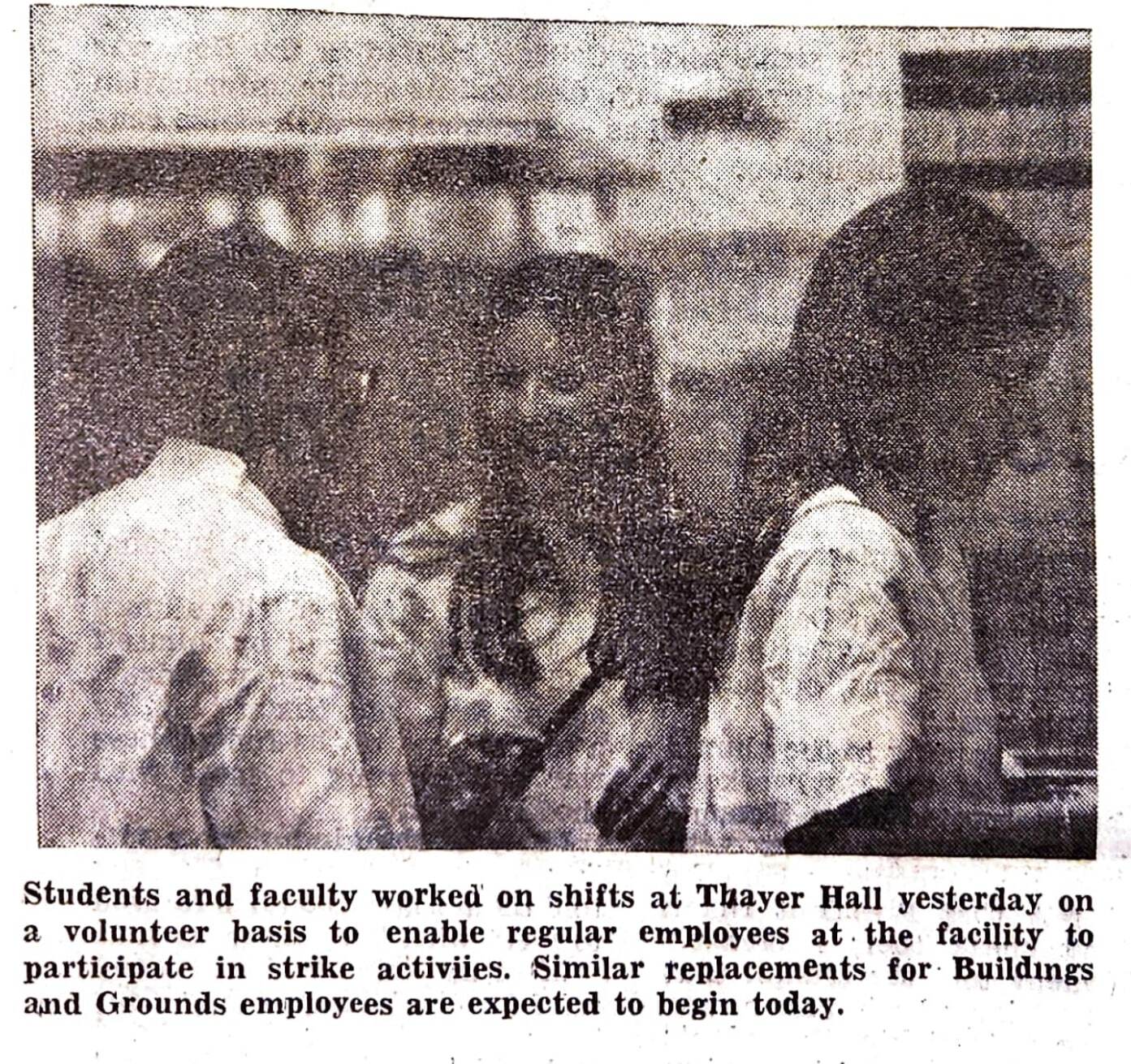
Photo in The Dartmouth capturing students & faculty working shifts at Thayer Hall during the 1970 strike.
Finally, faculty often found informal methods of supporting arrested students unable to attend class. Professor Marysa Navarro-Aranguren recalls how she sought to accommodate the eight of her students who were under arrest:
Professor Emeritus of Anthropology Hoyt Alverson supported his students in similar ways:
Exchanges such as these reveal how there was not a hierarchical relationship between faculty and student antiwar groups. Despite being constituencies in their own right, they often found themselves standing shoulder-to-shoulder—be it on the steps of Parkhurst or on prison grounds—expressing solidarity in their dissent for the antiwar cause.
“[Nixon is] faced with the bankruptcy of his policy; he’s caught like a rat in his trap.”
— Professor of Government Richard Sterling at a 1972 protest

"ROTC, War Protest on Parkhurst Steps"
Article in The Dartmouth describing the April 17, 1972 anti-ROTC protest.