Fresh Out of Officer Candidate School: Junior Officers and the Vietnam War
A Dartmouth Vietnam Project (DVP) Digital Exhibit
By Joanna Jou '26
This digital exhibit could not have been possible without the support of Professors Edward Miller and Mara Gregory, whose guidance made conducting oral history and digital humanities a worthwhile experience. Additionally, I would like to dedicate this collection to my DVP interviewee, Mr. Allan Campbell '64, whose insights and experiences served as inspiration for my work.

Midshipmen during Vietnam War

Navy OCS Recruiting Poster, c. 1950s
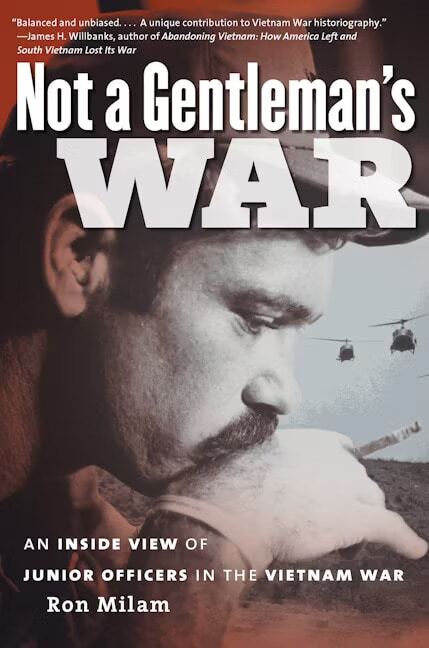
In Not a Gentleman's War, the author Ron Milam defines a junior officer as a second or first lieutenant—the lowest-ranking commissioned officer in the chain of command; other terms synonymous with “junior officer” include “platoon leader” or simply “lieutenant.” During the Vietnam War—and today—there are three primary routes to becoming a junior officer: the US Service Academies, Reserve Officers’ Training Corps (ROTC), or Officer Candidate School (OCS).
The US Service Academies: Consisting of 5 different federal institutions—the US Military Academy in West Point, NY; the US Naval Academy in Annapolis, MD; the US Coast Guard Academy in New London, CT; the US Air Force Academy in Colorado Springs, CO; and the US Merchant Marines Academy in King Point, NY—these service academies are a structural path for students to receive a four-year college degree while training to become commissioned junior officers in their respective armed forces branches. Upon graduation, cadets and midshipmen are commissioned as either ensigns (Navy, Merchant Marine, Coast Guard) or second lieutenants (Army, Air Force) and must fulfill a minimum of five years on active duty, followed by three years in the reserves—a total of eight years of service, with various specialties requiring longer commitments.
Reserve Officers’ Training Corps (ROTC): Formally established during World War I, ROTC is an officer-based training program offered at civilian colleges and universities for gaining commission in the military. While the ROTC program is only available for the Army, Navy, and Air Force branches, graduates of Naval or Air Force ROTC also have the option of serving in the Marines Corps or Space Corps upon fulfilling additional requirements. Cadets participate in basic military training—such as leadership training exercises, field drills, and off-campus summer programs—in addition to their academic coursework. Upon completion of ROTC, graduate officers are commissioned at a junior officer level (ensign or second lieutenant) and must serve both a minimum number of years on active duty and a reserve commitment.
Officer Candidate School (OCS): OCS is offered for college graduates who did not complete ROTC and non-commission officers (such as enlisted personnel) to assess their potential for commission. The length of the OCS training program varies depending on the branch, but typically includes classroom instruction, basic military training, physical training, and leadership development. Upon completion, individuals attain the junior officer level commission—second lieutenant or ensign—and serve a minimum of three years on active duty.
Regardless of commissioning source, many junior officers during the Vietnam War were quickly deployed to the frontlines after training, with limited experience. Rather than gaining leadership experience gradually from deployment experiences, many junior officers in Vietnam were assigned platoon command immediately after training. Lieutenant William Calley was a notorious example of junior officers being “no-talent, poorly trained, and unmotivated,” though Milam—who was a junior officer himself—asserts that Calley was an anomaly; contrary to popular belief, most junior lieutenants were efficient, dedicated, and committed.