
Navy OCS during the Vietnam War Era
This section examines the experiences at Naval Officer Candidate School during the Vietnam War Era through the accounts of Rob Mason and Allan Campbell '64.
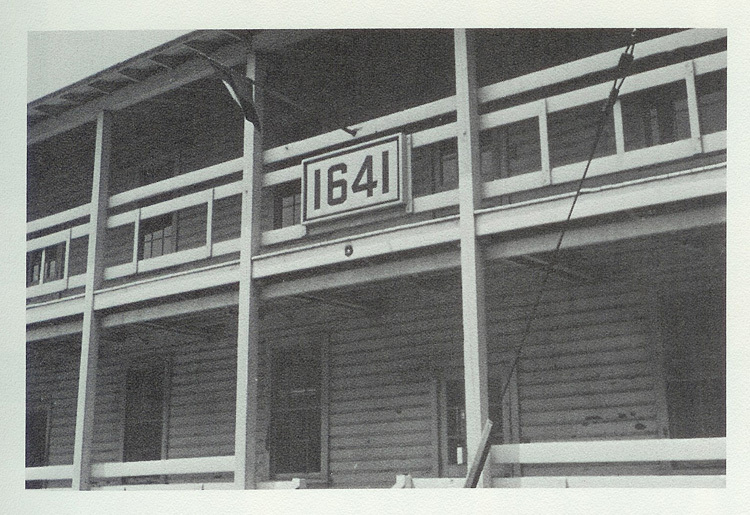
"1641" is in reference to the Officer Training Command Newport (OTCN), the home of Navy Officer Candidate School (OCS)
“If I hadn't gone to OCS or done something like that, I probably would have been drafted. So it was an alternative to just be vacuumed up into the lower ends of the military."
Allan Campbell '64; Junior Officer in the US Navy
Motivations for Naval OCS
In his blog, former Navy officer Rob Mason recalls how, in 1961, it became “fairly obvious” that his draft number would come up; the Cold War was in “full swing,” and the draft board was highly active. His decision to attend Naval OCS was influenced by three Naval Reserve officers, who told him he might never attain the status of a “gentleman” his whole life; however, if he became a commissioned officer, he would automatically gain this status. Though “gentleman status” was not his primary motivation, Mason found the idea of OCS intriguing after reading The Caine Mutiny by Herman Wouk in high school. Thus, with a B.S. in Engineering from Oregon State University—the basic requirement for acceptance into OCS—Mason took the entrance test and began the four-month process to receive commission in Newport, RI.
Similarly, in his oral history interview, Allan Campbell ‘64 recalls how the Cuban Missile Crisis in 1962 was the first time he thought about potentially serving in wartime. Reflecting on the political atmosphere during this time, he recalls, “[w]e [Campbell and his fraternity brothers] all literally felt—and never felt that way before—that we might be in uniform before the end of the school year. It was a pretty scary thought.” As student deferments were disappearing, Campbell faced the real possibility of being drafted upon graduating from Dartmouth in 1964. He states, “[i]f I hadn't gone to OCS or done something like that, I probably would have been drafted. So it was an alternative to just be vacuumed up into the lower ends of the military." Upon graduating from Dartmouth, Campbell started Naval Officer Candidate School on September 19, 1964 and was commissioned in February of 1965. While the commitment for commissioned service was three years, he served four years of commissioned service until September 9, 1968.
Classes
Mason notes six academic divisions in OCS: Seamanship, Navigation, Operations, Weapons, Orientation and Engineering—with Seamanship and Navigation being his favorites as they provided essential knowledge for life at sea. Moreover, he remembers, “engineering was fairly easy for me because I already had an engineering degree and my former instruction was still fresh in my mind. However, many candidates without engineering degrees often had trouble with that category.” Beyond academics, marching was another essential component of training.

Men marching during Naval Officer Candidate School
Uniforms
Campbell describes Naval OCS as being modeled after the Naval Academy, with four levels equivalent to each year, or class, at Annapolis: Plebe, Third Classman, Second Classman, and First Classman. “A lot of the curriculum was modeled on the Naval Academy. The uniforms were the exact same as the Naval Academy—different from enlisted, different from officers, but same as Annapolis.” Mason also echoes this observation, writing that the Officer Type Uniforms (OTUs) issued halfway through the program were “essentially the same uniform worn by Midshipmen 4th Class (Freshman) at the Academy.”
Nonetheless, Campbell points out that USNA officers would not necessarily see Academy and OCS officers as equals. He says, “[n]ow if you ever said to a Naval Academy person that an OCS commissioned officer was the same as somebody that had spent four years at 'Canoe U' as it was derogatorily referred to, they would look at you like you were crazy.” Mason similarly recounts his interaction with a young man in Newport, RI, when candidate privileges were increased and they were free on weekends. Mason describes an “arrogant and condescending” exchange when the young man assumed Mason was a plebe (a freshman midshipman) because he was wearing his OTU. Mason reveals that the young man was a rising senior at the Naval Academy, but wasn’t going to graduate and get his commission until the following summer. Mason then realized that, since he was already halfway through OCS and held a degree, he would get commission earlier than the young man—making him “senior” to the soon-to-be first classman (fourth year) at the Naval Academy.
"On the other hand, I already had a degree and since I was more than half way through the four month program at OCS I would receive my commission long before he did. That, in turn, would mean that in our future naval careers, if all other things were equal, I would always be considered senior to him. "
Rob Mason; Junior Officer in the US Navy

Rob Mason, Class Fifty-Five of Naval OCS
Graduating from Navy OCS
"Usually they [the Navy] would assign you to where you were going to end up based upon, obviously, the needs of the service”, says Campbell. He describes how each candidate filled out a “dream sheet,” listing where they would like to be stationed after graduating from OCS. “They call it a dream sheet for reason; it ends up mainly being a dream.” Thus, Campbell got assigned to a large combatant, Naval Justice School, and the East Coast, ultimately having a military occupational specialty (MOS) of legal officer on the USS Essex. On the other hand, Mason was assigned as an assistant navigator on the USS Pictor and later became a communications officer. Both Campbell and Mason would be considered ensign rank, the lowest/junior commissioned rank in the US Navy.
“They call it a dream sheet for reason; it ends up mainly being a dream.”
Allan Campbell '64; Junior Officer in the US Navy