
An Exodus Foretold: The 1954 Catholic Migration
During World War II, the Japanese staged a coup against French authorities in Vietnam and declared Vietnam's independence under King Bảo Đại. However, this new state had little real power, and local leaders, including religious groups, had to step in to maintain order. In 1945, Hồ Chí Minh proclaimed the Democratic Republic of Vietnam (DRV) with the goal of gaining international recognition and uniting the Vietnamese people under the Việt Minh.

Chaplain assists Vietnamese refugees on USS Bayfield, 1954
During the 1954 Northern Migration, Operation Passage to Freedom evacuated nearly 300,000 Vietnamese refugees from North to South Vietnam aboard ships like the USS Bayfield.
To win the fight against French colonial rule, Hồ Chí Minh needed broad support. He emphasized that every Vietnamese person, regardless of their background, could contribute to the cause—including Vietnamese Catholics. He envisioned a decolonized Church led by Vietnamese priests and bishops and allowed dioceses such as Bùi Chu and Phát Diệm in northern Vietnam to maintain autonomy and operate their own self-defense militias within the DRV.
However, the unity within the DRV was fragile. The French exploited these divisions by appealing to ethnic minorities and religious groups, promising them greater autonomy. Meanwhile, the Cold War intensified, and the Chinese Communist Party’s support for the Việt Minh encouraged the Soviet Union to back them as well. In response, the French sought U.S. support, leading the United States to see Vietnam as a critical front against communism.
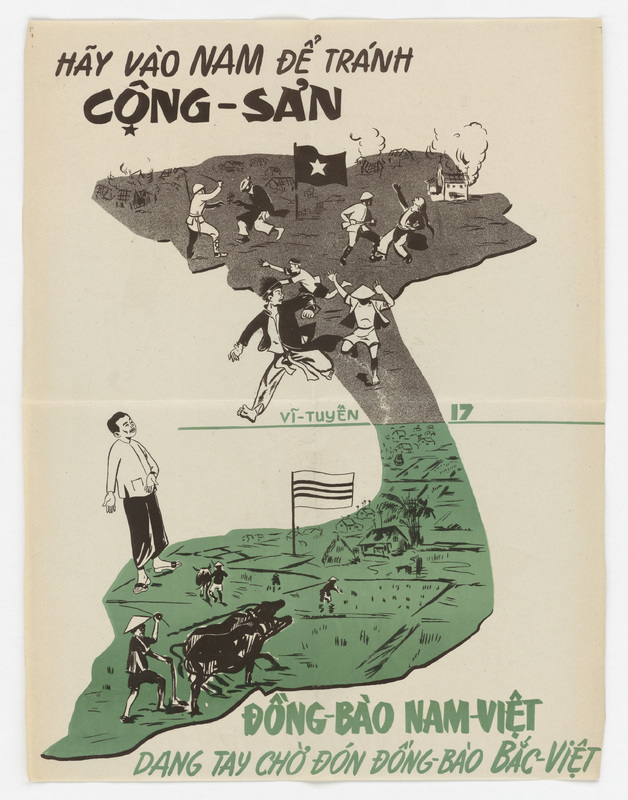
Come South
Propaganda posters like this were common during this era. The top caption reads, "Go South to avoid Communism," while the bottom caption encourages unity: "Southern compatriots are welcoming Northern brothers and sisters with open arms."
For Vietnamese Catholics, the conflict became both a physical and spiritual battle. The Vatican opposed communism, declaring that Catholics should not support any activities promoting communist atheism. This stance forced many Vietnamese Catholics to choose between their loyalty to the DRV and their religious beliefs. Initially-supportive Catholics became disillusioned as they faced hostility from communist cadres, especially in Bùi Chu and Phát Diệm, where communist policies led to the destruction of religious sites and persecution of Catholic communities. Rising tensions led Bùi Chu and Phát Diệm to break away from the DRV and align with the State of Vietnam (ASVN) in Saigon.
As the First Indochina War ended, the Geneva Conference in 1954 resulted in Vietnam being temporarily divided into two zones. Even before an official agreement was reached, Catholics in northern Vietnam began migrating south. Over 800,000 people fled the north, with Catholics making up 85% of the migrants.
This Catholic migration sent a powerful political message during the Cold War. It symbolized a rejection of communism and support for the emerging postcolonial state in South Vietnam. Many evacuees believed their movement was not just a personal decision but part of a national and global mission to reclaim the north.
In the south, these Catholic evacuees were seen as model citizens under Prime Minister Ngô Đình Diệm, who came from a deeply Catholic family. However, they also struggled to persuade or confront segments of southern society that saw the DRV as a legitimate nationalist state. Some southerners accused Diệm’s regime of the same violence and intolerance that northern Catholics had experienced under the DRV.