
Maintaining Faith and Preserving Heritage
After resettling in the United States, Vietnamese Catholics focused on preserving their religious and cultural heritage by establishing parishes, societies, and publications. They emphasized the need for Vietnamese-language Bibles and prayer books and advocated for the creation of Vietnamese religious centers. These efforts helped maintain their nationalist and Catholic identity while adapting to life in a new country. As Trey Pham noted:
"The Catholic Church was the pillar of our community. It was where we met, supported each other, and built our new lives."
The church became a crucial support system, bringing together not only Vietnamese refugees but also other Southeast Asian immigrants. It offered a sense of community and stability:
“Each year, new families arrived, and the community grew—Cambodians, Laotians, Chinese, and, of course, Vietnamese. The church brought us all together.”
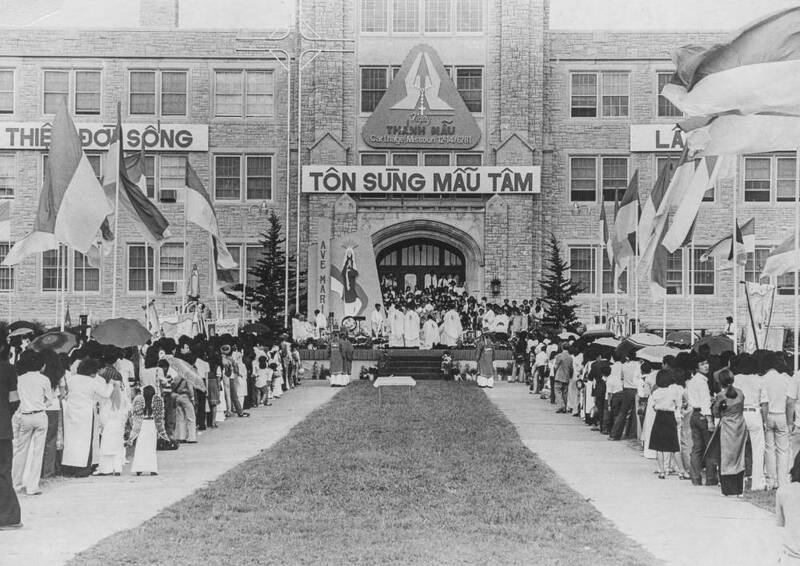
Marian Days
Vietnamese Catholics gather in Carthage, Missouri, for one of the earliest celebrations of faith, culture, and community: a tradition that has since grown into the largest annual gathering of Vietnamese Catholics outside of Vietnam.
A powerful example of this preserved heritage is the annual Marian Days festival in Carthage, Missouri. This event draws 60,000 to 70,000 Vietnamese Catholics each summer for a four-day celebration of faith, culture, and community. It is the largest gathering of Vietnamese Catholics outside of Vietnam, featuring religious ceremonies, cultural performances, and opportunities to reconnect with family and friends.
The festival highlights how deeply faith and tradition remain woven into the fabric of Vietnamese American life. It also fosters chance encounters and reconnections within the community:
“So, so that’s how we met again, through, through Catholic church again, you know, the one time we both happened to be at Mass, you know, at the same time. So if I can say, maybe it was fate, I guess.”
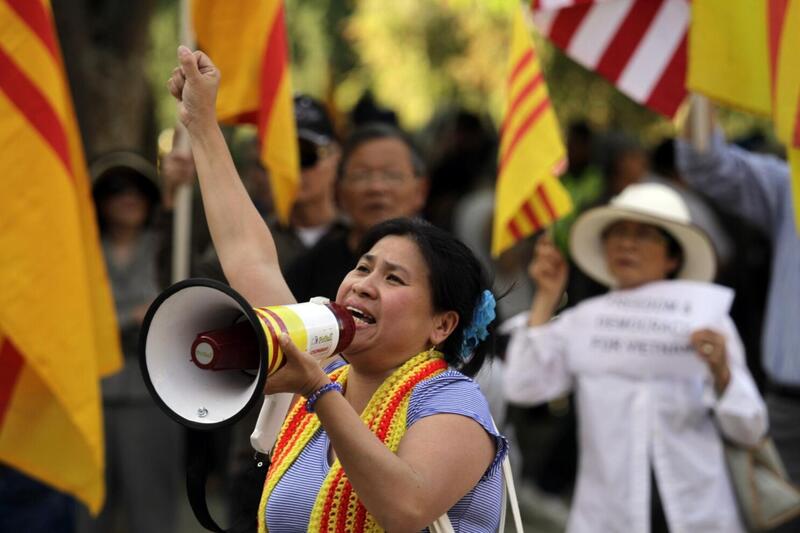
Protester Dung Nguyen
Dung Nguyen was among hundreds of Vietnamese Americans protesting outside the Irvine council meeting over a proposal to establish a “friendship” with Nha Trang.
Decades after the Vietnam War, Vietnamese American anticommunism continues to be a powerful force within the community. In 2014, hundreds of Vietnamese Americans protested at Irvine City Hall against a proposal to add the Vietnamese city of Nha Trang to Irvine’s friendship city program. Shortly after, around five hundred protesters gathered at the Chinese consulate in Los Angeles, voicing their condemnation of the communist governments of China and Vietnam. Their chants of “down with red China” and the act of trampling on the Chinese flag underscored the enduring intensity of their anticommunist beliefs.
For many Vietnamese Americans, these protests are not just political statements but expressions of a deep-rooted connection to their homeland and a continued hope for a free Vietnam. Many in the community hold a nuanced view of the war and its lasting impact. As Trey Pham reflected:
“Yeah. I was telling Professor [Edward] Miller, I always said there is no real winner in any war, right? The people that suffer the most is always the regular, everyday people. I mean, most of us didn't understand why there was a war. I mean, we understand the basic concept, the communists, and all that stuff. But on an everyday level, most of us were just trying to go on with our life, trying to provide for our family.”
His perspective highlights how, for many Vietnamese, the war was not about grand ideologies but about survival and the struggle to maintain a sense of normalcy amidst chaos. This sense of loss and resilience is echoed by others in the community. One cetnral Vietnamese businessman described his deep love for Vietnam and a persistent hope of returning to a non-communist homeland:
“Of course, we must love our land, our country where we were born, where we have our own parents, where we have the tombs of our ancestors. The fact that we had to leave our country was something against our will. When we left our country, we turned our heads and cried. And after many years of living in America, we still remember our country.
One day, if the Free World can do something to bring freedom back to Vietnam so that everyone can go back, that would be a very precious thing. Just because we have a comfortable life in America, we’ll not forget our country. We pray and hope that one day Vietnam will cease to be a Communist regime so that we can return to our country.”
Ultimately, the Vietnamese Catholic story is a reminder that communities are more than just political identities or historical footnotes. They are living, evolving tapestries of experiences, memories, and aspirations. Through their churches, festivals, and quiet acts of faith, Vietnamese Catholics have created spaces where their history and hope can coexist—demonstrating how a community can remain anchored in its roots while still reaching toward a new and hopeful future.