
LRRPs in the Aftermath of the War
In the Face of Tragedy: Experiencing Grief and Regret
"It took 25 years for me to get the nerve to do it. To contact his family, and to talk to them." - David Flores

A photograph of a memorial for an entire LRRP team, taken in Vietnam
The danger of LRRP missions meant that the loss of team members was a daily reality for LRRPs, and the close-knit dynamic of most LRRP teams meant that each loss was deeply personal. Flores recalls a tragic experience when his LRRP team was sent on an ambush during a holiday truce on New Year’s Eve of 1968. His team was sent 1,000 meters away from the base camp to set up an ambush and realized too late that the area had been booby-trapped. Moments after, an explosion killed Flores' friend Ron and injured three others. The death of his friend weighed heavily on Flores. 25 years later, Flores decided to contact Ron’s family to meet them. He learned that Ron’s family was only notified by the U.S. Army of his death on January 2, 1969, perhaps to obscure the fact that an ambush had been ordered during a period of truce. Flores’ story is one of many that reflects the role of grief in shaping the LRRP experience. Losing a teammate not only lowered morale in the short term but also inflicted emotional and psychological pain that lasted beyond their time of service.
Memories of the War and the Return to Civilian Life
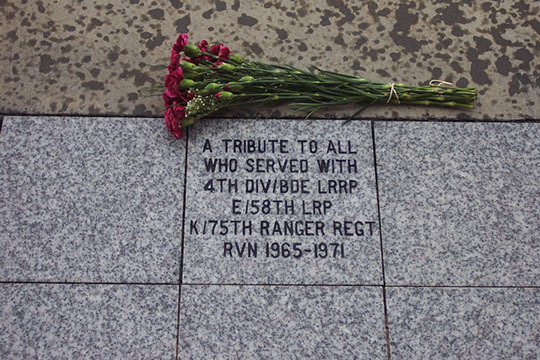
Photograph of a memorial for LRRPs and Rangers
"He's e-mailed me several times and wants to get together, but it's one of thise things; you want to do it but then you're hesitant to do it." - Terry Massey
As a site of powerful emotions, the Vietnam War occupies a contested space in veterans’ memories. LRRPs' wartime experiences influenced the circumstances of their return to civilian life and their relationship vis-à-vis the war, on both a personal and political level. Upon returning to Dartmouth after the end of his service, Holmen did not join veterans' associations. He sought to distance himself from any connection with the Vietnam War, as his views on the war had changed after his service. Massey experienced a similar situation: he only reconnected with his military peers in 2011-2012 and was hesitant to attend reunions. However, Holmen decided to attend his first LRRP reunion in 2007 and found it to be a fulfilling experience. Since then, he has attended another reunion in 2024, written several books about his experiences as a LRRP in Vietnam, and administered a website dedicated to commemorating LRRP stories.

Group picture taken during a LRRP reunion
"Historically, I didn't really want too much to do with it. I never joined the American Legion. I never joined the VFW, Veterans of Foreign Wars. I never went to reunions. I had probably a, basically an anti-military attitude. That has changed." - Obie Holmen
Holmen and Massey’s stories reflect the separation of military and civilian life that several veterans observed in the immediate aftermath of the war. Seeking to distance themselves from the pain and tragedy of the war, some LRRP veterans avoided membership in veterans' organizations and other military associations altogether. However, spatial and temporal distance from the war enabled healing and reconciliation. With time, many veterans have experienced a transformation of their relationship to the war.