
The Journey to Becoming a LRRP
What is a LRRP?
The US Army Field Manual (FM) 31-18, published in August 1968, defined the Long Range Reconaissance Patrol (LRRP) as a “military unit specially organized, equipped, and trained to function as an information-gathering agency responsive to the intelligence requirements of the tactical commander.” During the Vietnam War, LRRP underwent periods of structural reorganization. The first period began in December 1965, when the 1st Brigade, 101st Airborne Division created the first provisional LRRP unit and other brigades followed thereafter. The second period began in late June 1967, when two long-range patrol companies were formed for I and II Field Forces. The third period began in February 1969, when the Department of the Army rolled in LRP companies as Ranger companies of the 75th Infantry Regiment. Given this history, not all Rangers were LRRPs, but all LRRPs were designated Rangers by the end of the Vietnam War.
The Journey to Becoming a LRRP
Personal Motives
“I volunteered to be a LRRP for one reason primarily, and that is, although we would have to go on missions in the jungle, which could be dangerous, and were, but we also got to live in the rear." - Obie Holmen“I truly felt that after listening to the names of former cadets that I knew and loved who were killed in action almost on a daily basis (...) that with all the training that I had, I could save lives.” - Gary Dolan“When we were accepted and they gave us our mailing address it was Company K, 75th Rangers, and I thought, “God, what did I get myself into?” I didn't know I was getting into a Ranger unit!” - Terry Massey“I was willing to take the risk to get out of that drudgery.” - Don Hall

Photograph of two LRRPs in action in the jungle
The journey to becoming a LRRP is far from monolithic. Every LRRP had their own reasons for joining the unit. Given LRRP’s reputation as an elite special operations unit, some men sought to leverage the superiority of their tactical skills and their unwavering patriotism by becoming a LRRP. Gary Dolam, the Platoon leader for the LRRPs of Company C, 75th Airborne Infantry Regiment (Rangers), expressed such a sentiment in his oral interview: upon learning that many of his fellow cadets had died in the Vietnam War, Dolam volunteered for the LRRP unit as he believed that his skills and extensive training would allow him to save lives. Pragmatic considerations were equally prevalent in influencing soldiers’ decisions to join the LRRPs. Holmen, Hall, and Massey became LRRPs because they found it preferable to serving as infantrymen. However, rather than falling sharply into the category of pragmatism or ideology, a soldier’s personal motive usually contained elements of both.
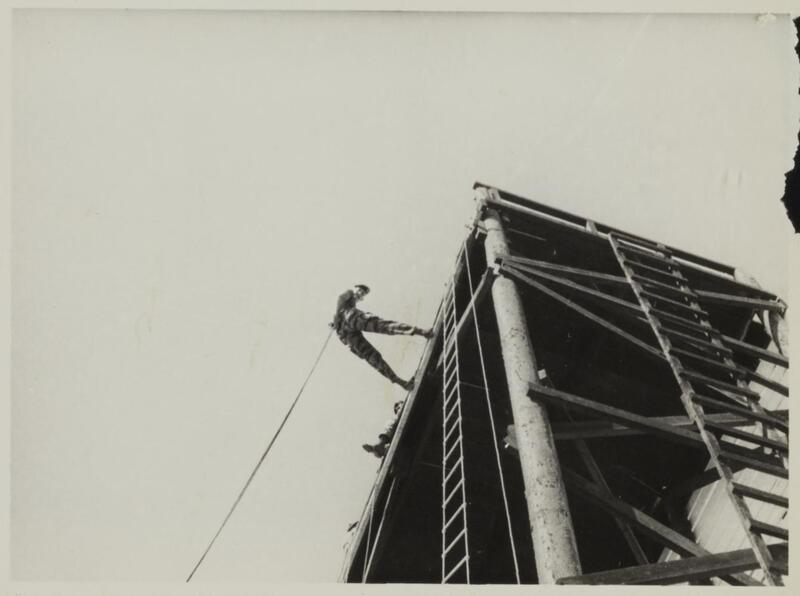
Photograph of a man rappelling at MACV Recondo School
Training
LRRPs have diverse identities, combat experience, and training. Most LRRPs attended Ranger School at Fort Benning or received specialized training at the MACV Recondo School. Ranger School involved a 62-day course, training soldiers in combat, tactical skills, and other skills necessary for Ranger missions. While not a substitute for Ranger School, the MACV Recondo School at Nha Trang offered a 2-week long course and provided specialized training in non-conventional military skills and special warfare. However, some LRRPs, like Holmen, were recruited into LRRP units after their initial assignment into an infantry unit and did not receive any specialized training. Regardless of the reason or circumstances of their entry, all LRRPs displayed a high level of skill as field soldiers. This is certainly the case for Holmen, who had ample combat experience and was awarded his first Bronze Star prior to joining LRRP.

US Army Field Manual FM 31-18, Long-Range Reconnaissance Patrol Company (LRRP)
A document published by the Department of the Army which contains information on the historical formation of LRRP, outlines of missions, and standard operating procedures (SOPs)
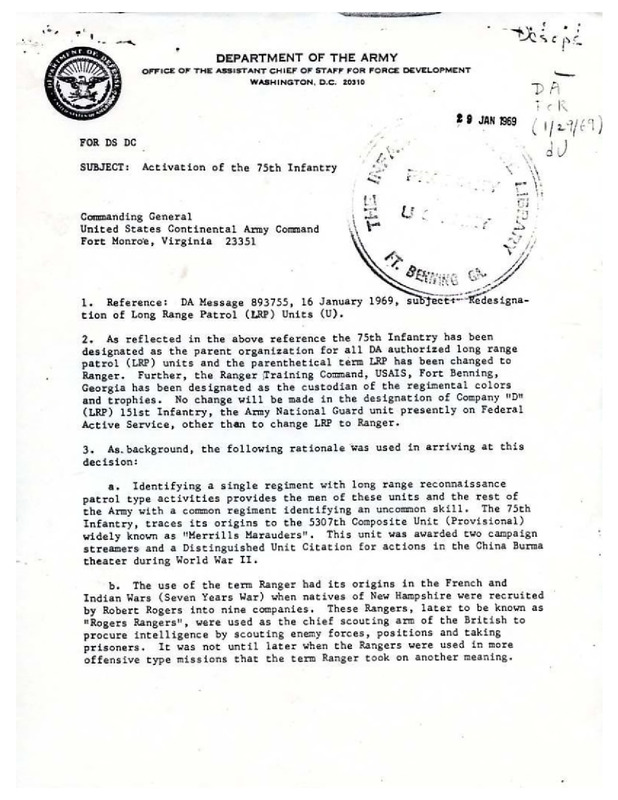
Department of US Army Document: Activation of 75th Infantry Regiment (Rangers)
A document created by the Department of the Army which articulates the restructuring of LRRP units during the Vietnam War