
Chapter 13
Family Roots and Early Life in Vietnam
The narrator’s family history is deeply entwined with turmoil and upheaval in Vietnam. Her maternal grandmother, forced to flee the violence and instability in North Vietnam, sought refuge in the South with her children, while her paternal family hailed from the southern part of the country. Growing up in a family that valued education and close-knit relationships, the narrator’s parents instilled in her a strong sense of responsibility, especially toward education and the family. Despite the strains of war, she maintained close ties with her extended family, including her aunt, cousins, and grandmother, all of whom played a pivotal role in her life.
Escape from Vietnam and Separation from Her Father
In many ways, the narrator’s experience mirrors that of Lai’s. Like Lai, she escaped Vietnam with only her mother, driven not just by her own ambition but also by a deep understanding of the tragedies unfolding around her. She recognized the privilege of receiving an education in a war-torn country and did not take that opportunity for granted. Though she was never directly involved in the conflict, her knowledge of the Communist regime came primarily through the stories passed down by her parents and grandparents. Her parents painted a vivid picture of the struggles, but she herself was shielded from the immediate horrors of the war.
As the North Vietnamese army inched closer to Saigon, the family’s hopes of escaping grew desperate. In the final hours before the city fell, the narrator's mother managed to secure a spot on an American ship leaving the country. The rush to board the ship was frantic, and in the chaos, her father, who was still seeking alternate routes of escape, was left behind. The separation from him was a heartbreaking and traumatic moment for the family.
Life in Guam and Moving to the U.S.
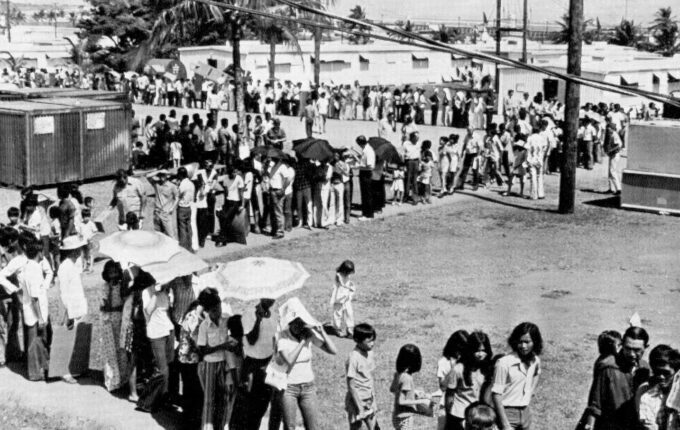
After escaping Vietnam, the narrator and her family were taken to Guam, where they found refuge with the help of a local family sponsor. It was a difficult adjustment, but the narrator, being a child, found solace in the friendships she made with other children on the island. Her mother and aunt worked tirelessly to support the family, each enduring their own trials as they tried to rebuild their lives.
However, the narrator’s mother was overwhelmed with worry for her missing husband. In a moment of desperation, she considered returning to Vietnam by boat to search for him. But after careful thought, she realized she could not abandon her children and made the decision to stay in Guam and focus on caring for them. This decision marked a pivotal moment in the narrator’s life, one that shaped her understanding of sacrifice and the strength required to protect her family.
Though the narrator had grown fond of the tight-knit Vietnamese community in Guam, she viewed the United States as a land of opportunity—a place where she could forge a better future. After spending three years in Guam, her family made the difficult decision to relocate to California. The warm climate and the presence of large Asian communities were factors that made California an attractive choice.
Adapting to American Culture and Holding Onto Her Vietnamese Identity
Upon their arrival in California, the narrator was struck by the materialism and consumer-driven culture that seemed to define American society. Her idealized view of America, shaped by the wealth she had witnessed while living in Vietnam, quickly began to dissipate. She learned that American involvement in the war had contributed to the destabilization of Vietnam’s economy, the rise of drug addiction, and the exploitation of young women through prostitution. These realities conflicted with the idealized image she had held, making her disillusioned with the American lifestyle.
Additionally, the racial discrimination faced by minorities in the United States stood in stark contrast to the cultural unity the narrator had experienced in Vietnam. She struggled to find a balance between the material excess she saw around her and the more restrained, morally-grounded values she had been raised with. Yet, despite her discomfort with certain aspects of American society, the narrator also appreciated the progressive ideals that the U.S. embraced. She found a certain harmony in blending the best of both worlds—the freedom and progressiveness of America with the moral foundations from her Vietnamese heritage.
As the years passed, the narrator remained deeply committed to her Vietnamese identity, determined to preserve and pass down her cultural traditions to her children. She felt a deep responsibility to ensure that they would grow up with a strong sense of who they were, regardless of the challenges of adapting to life in America. Above all, she was determined to use her position in the United States as an opportunity to advocate for those still suffering under the Communist regime in Vietnam. She sought to be a voice for those who had none, hoping that her experiences could shine a light on the struggles faced by her homeland.