
The Space Between
I. Distance From the Truth
True to its name, the Secret War was characterized by intense secrecy—not only from the outside world but also among those directly involved. Before landing in Udorn and Laos, Michael Beahan received minimal education about Laos and Thailand, particularly in comparison to his intelligence curriculum based on Vietnam. While there was somewhat more familiarity with the Ho Chi Minh trail in southern Laos due to its connection to the broader Vietnam War, even less was known about Operation Barrel Roll and the ongoing conflict in the Plain of Jars region where these American and Hmong air force personnel operated. This lack of knowledge was deliberately maintained by the U.S. military. Volunteer Raven pilots like Mike Cavanaugh underwent a “sheep dipping” process, relinquishing their military titles and gear and assuming civilian identities. When transitioning into his role as a Raven pilot, Cavanaugh was explicitly told by his former colonel in Vietnam:
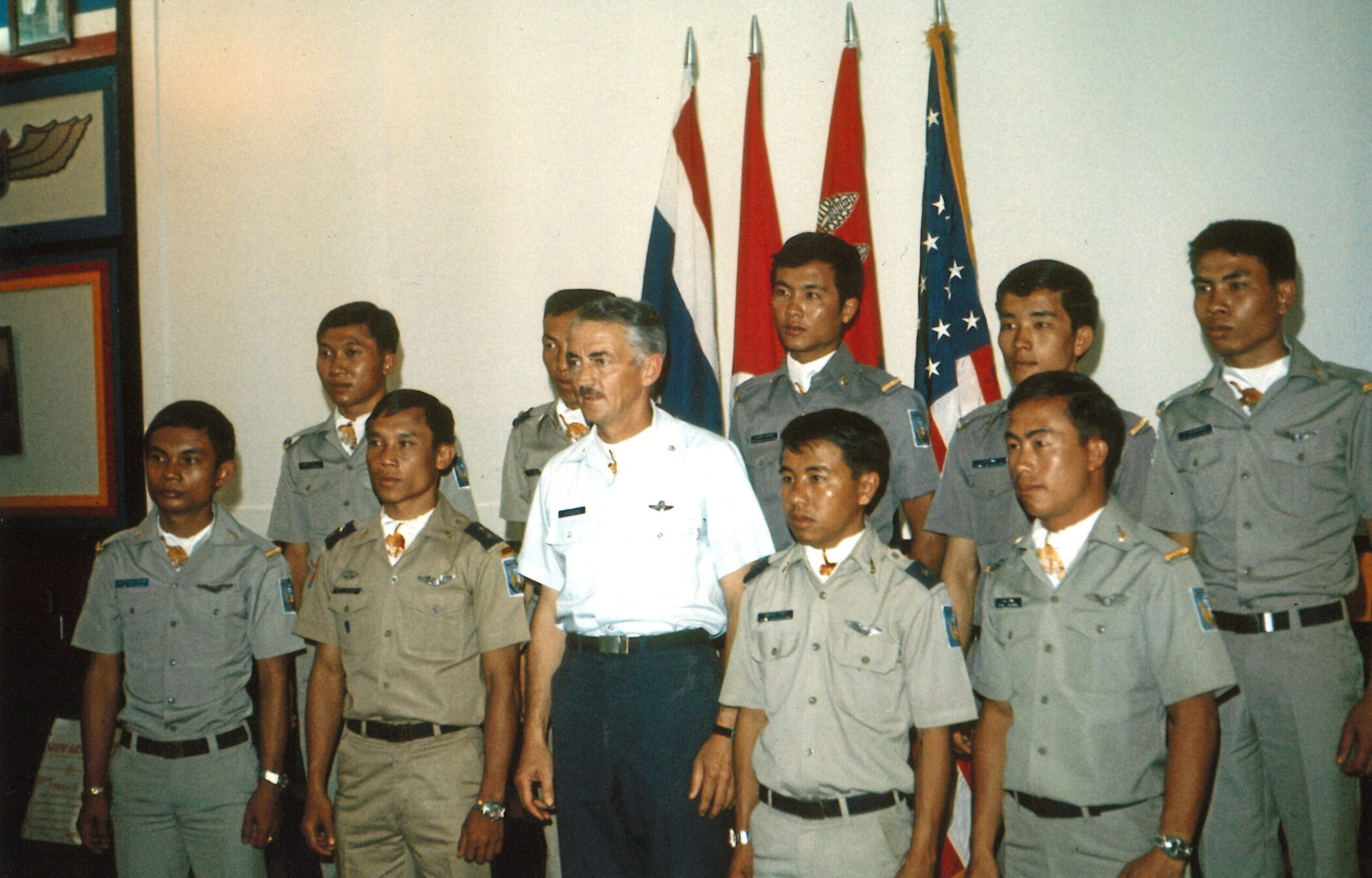
Hmong pilots' graduation ceremony, 1973.
Once in-country, Air Force personnel like Beahan were further distanced from highly sensitive matters. Intelligence personnel deliberately isolated themselves, refraining from sharing details or allowing questions about their activities even from fellow Americans. The CIA operated through Udorn Air Force Base, as did Beahan and Cavanaugh, yet they maintained separate facilities including their own hotel and officers' club, rarely interacting with the pilots and Air Force officers.
Hmong pilots and their families also faced significant barriers in gaining complete information, though this resulted from structural and logistical challenges rather than orchestrated secrecy. Many Hmong pilots identified their training as particularly inadequate, describing it as heavily bureaucratic and scary, with some suspecting the program was intentionally flawed or set up to fail. In addition, inconsistency in U.S. flight trainers’ abilities and willingness meant Hmong pilots often completed training with varied or incomplete skill sets. A natural language barrier also hindered proper communication. Frequent changes in program requirements and the cyclical, temporary nature of American leadership and oversight meant some Hmong pilots repeatedly revisited the same language and training courses before ever participating in active missions.
Americans like Beahan may have operated with an ideological understanding of the greater rationale for the war rooted in anti-communism, believing they were fighting the war against the common enemy of Northern Vietnam. On the other hand, some Hmong pilots expressed a more intimate awareness of the war, tied to their lived experiences and collective survival. Hmong pilot Vang Kha describes Lee Lue’s role in the war as: “he was just doing his job. He was not doing this just for himself. He was doing this job to help out the entire community.” While the Hmong may not have been fully knowledgeable about the complex geopolitical reasoning of U.S. intervention, they were intrinsically motivated by the immediate need to protect their families, villages, and livelihoods.
II. Distance From Death
At a literal level, American crew members like Michael Beahan flew at high altitudes, often above 30,000 feet and well out of enemy gunfire range. Hmong pilots like Lee Lue flew low to the treetops in order to get proper reconnaissance and were exposed to constant fire. Lue once told Cavanaugh: “Hey Mike, you’re an astronaut.” Despite the fact that they held the same role as forward air controllers, they experienced differing risks and norms around the danger of the job.

U.S. Air Force Ravens, flying over Northeastern Laos.
Of the thirty-seven Hmong pilots who graduated from the training program, seventeen were killed in action. Many Hmong accepted this grim reality when they took the job, realizing that an open spot was likely due to the passing of a prior pilot. Some, like Koua Xiong, rationalized their fate, stating: “if you die, you die abruptly without time to feel pain. We would all die someday.” For many Hmong pilots, survival was a daily gamble. As Xiong later put it: “If he shot you, he survived and you died. If he missed you, then he died. It was either him or me.” American pilots and Air Force personnel like Michael and Mike were exposed to a plethora of dangers, but in flying at a different attitude and having different roles, the types of dangers were different: more operational rather than directly combat-related.
III. Distance from the War

Udorn Royal Thai Air Force Base, from the air.
The contrasting experience of American pilots stationed at Udorn Royal Thai Air Force Base and Hmong pilots operating out of Long Cheng, Laos dictated the physical and psychological space they found from their “day jobs.” Though Udorn served as a critical operational hub for the air war in Laos, Beahan called the Thai base quite “civilized,” with restaurants, nightlife, and a sense of normalcy—an atmosphere more like an R&R destination than an active war zone. The ability to retreat to this environment after missions, even to an apartment off base, reinforced the sense that the war was something they engaged in but stepped away from once their duty ended.

Lima Site 20A, Long Tieng, Laos.
In contrast, Long Tieng (known as Lima Site 20 Alternate), the nerve center of Vang Pao’s Hmong forces, was an entirely different environment with little demarcation between military operations and civilian life. As one account describes the so-called “secret city” of 40,000:
Pilot Lee Lue even took his father out on a bombing mission, blurring the thin boundary between family, work, and war. Unlike their American counterparts, whose tours typically lasted one year, Hmong pilots had no expectation of finishing a tour and returning home. The slogan for the group was “Fly until you die.” The only way “out” was death, disability, or capture.
These “distances” are all interlinked—geographical distance, social distance, psychological distance all compounded to create what many describe as the “fog of war.” Both American and Hmong air force personnel experienced their own distinct “Secret War,” shaped by their backgrounds and the contexts in which they fought. These factors continue to influence how they—and we as Americans—recount and reflect on their time in the war today.