
Tet Perspective: Mr. Steve Fowle
One of the most valuable ways to gain insight into the Tet Offensive is through first-hand accounts and testimony from soldiers and military personnel who witnessed or were involved with the attacks.
Steve Fowle served in Vietnam from June 1967 to June 1968. He worked taking photographs to assist pathologists in the morgue as part of the 9th Medical Laboratory, 44th Meiccal brigade in Saigon. His position and proximity to Saigon provided him with a unique perspective on the Tet Offensive and its impact on the city, as well as the raw and violent devastation it inflicted on American forces.

Mr. Fowle attended basic training at Fort Jackson, South Carolina before attending specialized photography training at Fort Monmouth, New Jersey. By the end of his training, Mr. Fowle was a specialist still photographer; however, he did not know what his duties would entail until his arrival in Long Bihn in June of 1967. He spent the next year living in and around Saigon, working as a medical illustrator taking photographs for autopsies at the medical lab. Although there is no official record of how many autopsies Mr. Fowle assisted, he estimates he worked on at least 300. In terms of American casualties, Mr. Fowle’s deployment aligned closely with the bloodiest months of the war.
“...I'm arriving there in June of '67, and things have been busy, and they're getting busier at the morgue… If you take a one-year frame and move it back and forth across the timeline of that war, it's just about as many people dying during that year as there are at any point.”1
In addition to his work in the lab, Mr. Fowle drove blood and medical personnel around Saigon and recalls his interactions both with ordinary Vietnamese and run-ins with the Viet Cong. Although he was never shot at while driving, it was common for Viet Cong fighters to patrol on scooters and shoot at American officers, making this line of work especially dangerous at times.
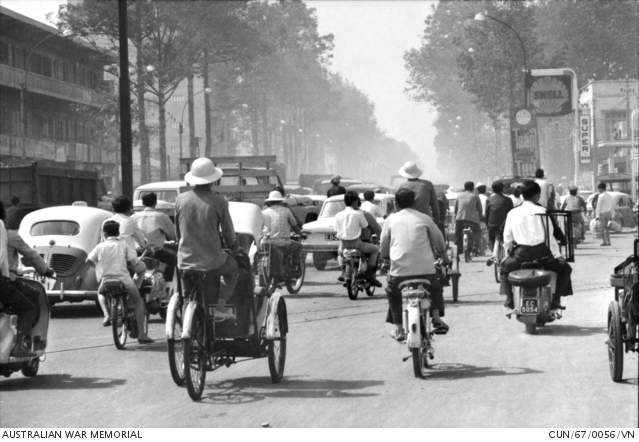
When asked about Saigon, Mr. Fowle described the incredibly busy city in detail, mentioning the dense crowds of street vendors, commuters, and various uniformed officials. He also recalled the diverse smells and foods that filled the city. However, when asked how Saigon changed after the Tet Offensive, he responded, “Completely. There are two different cities.” He did not elaborate much further on the state of the city following the attacks. This perspective challenges Moïse's contention that the Tet Offensive did not damage South Vietnam as severely as some claim. By asserting that Saigon, one of the cities hit hardest by the attack, transformed into a different place, Mr. Fowle confirms the deep and lasting impact of Tet. Even though this is just one indivual's perspective, it suggests that others felt the same. The perception of change could relate to the physical structure of the city, the social and emotional way that people interacted with each other, or the psychological effects as residents dealt with their new trauma and vulnerability.
On the eve of the Tet Offensive Mr. Fowle recalled being pulled for guard duty after moving to his new BEQ [Bachelor Enlisted Quarters] called Montana. He paints the scene of standing on the hotel’s roof and seeing the city lights of Saigon and red lines going from about 20 degrees above the horizon towards the ground. He later identifies this image as C130s flying around and shooting at the city. For guard duty, he carried an M14 rifle, a couple of magazines, and a flak jacket with a steel helmet. His job was to guard the BEQ from Viet Cong units and act if trouble arose. Following his first shift, he recalls being woken up in the early morning to a “crescendo of explosions,” only to learn they were rocketing Tan Son Nhut, an area only a mile north of his BEQ. The soldiers of the BEQ were instructed not to go anywhere or leave the complex.
Mr. Fowle provided insight into the psychological cost of working in his position as a medical illustrator during this time, noting that if he did not accept and acclimate to his gruesome duties, he could end up on the autopsy table. He expressed a similar sentiment when describing his memories of loss during the Tet Offensive:
“...You look over here, and there's a three quarter ton truck on its way to Tan Son Nhut. And you know where it's going, because in the back of the truck there's about five or six GIs, and they're laying down. And every time it hits a bump, the legs bounce. Because they're dead as shit. They're on their way to Tan Son Nhut and they're going straight to the morgue. There's no grave unit.”
1 Steve Fowle, videoconference interview by Mia Sisitsky, Hanover, NH, February 14, 2025.