
Alternative Education: Teach-ins & Curriculum as Antiwar Resistance
Teach-ins and the 1970 student strike
As news of the 1970 Cambodia invasion and the Kent State University shootings embroiled the nation, Dartmouth students initiated a campus-wide strike in favor of creating space to discuss the events that had unfolded. Correspondingly, President John Kemeny announced the week-long cancellation of classes, paving the way for a series of student-faculty teach-ins as an alternative curricular program.

Image from article in The Dartmouth titled "Preluding Moratorium, Teach-in Attracts Many." May 5, 1970.
On May 5, 1970, students packed the Top of the Hop for the first teach-in of the week: “Teach-in on Survival.” Throughout the evening, sixteen faculty and staff speakers—ranging from the Government to History Department—spoke on the Vietnam War issue from their respective fields of expertise. Professor and Black studies scholar Robert McGuire linked U.S. atrocities in Vietnam to the sense of “racial superiority” in the United States; Professor of Government Henry W. Ehrmann argued that the South Vietnamese government must conduct free elections per the mandate of the Geneva accords; and Professor of Chinese Jonathan Mirsky emphasized the “depth of nationalism” in Indo-China as a reason the U.S. must “forsake political and territorial ambitions.”
James Kloppenberg ‘73 recalls his impressions in particular of Professor Mirsky’s speech as a formerly conservative student:
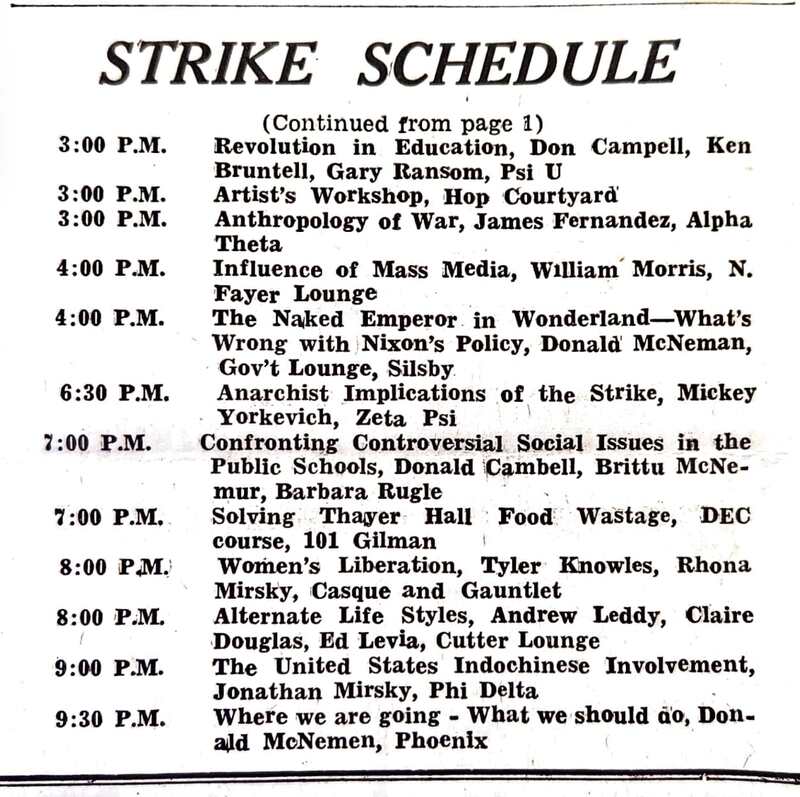
Clipping of "Strike Schedule" in The Dartmouth, listing the programming for May 6, 1970 during the student strike.
Why was it that these spaces of alternative education were so transformative for those who attended? Perhaps because, as Professor Eisenberg’s Fire and Rain reveals, misinformation was crucial to Nixon’s ability to escalate the Vietnam War. Myths regarding the status and origins of the conflict were systematically deployed to the national public: that the administration had been facilitating good faith troop withdrawals, that all aggression had been provoked by the North Vietnamese, and that continued U.S. involvement was necessary to obtain “peace with honor.” To challenge these claims was to destabilize the discursive infrastructure that sustained the U.S.’ Vietnam presence.
Kloppenberg’s testimony also highlights the distinct impact of the faculty’s endorsement of the strike. While student-led dissent was certainly equally powerful, the perception of “people in positions of authority” supporting them perhaps strengthened the movement’s credibility to onlookers who were initially skeptical.
The teach-ins of the 1970 student strike discussed not only the historical background of the Vietnam War, but also how that history could be translated into politics. For example, on May 7, 1970, Professor Mirsky spoke to an 800-person audience on effective rhetorical and persuasive tactics in canvassing against the war. According to The Dartmouth, Mirksy emphasized that “canvassers must convince the people of Vermont and New Hampshire to reject Nixon's policies on [the people's] own grounds...based on the ideals upon which this country was founded.”
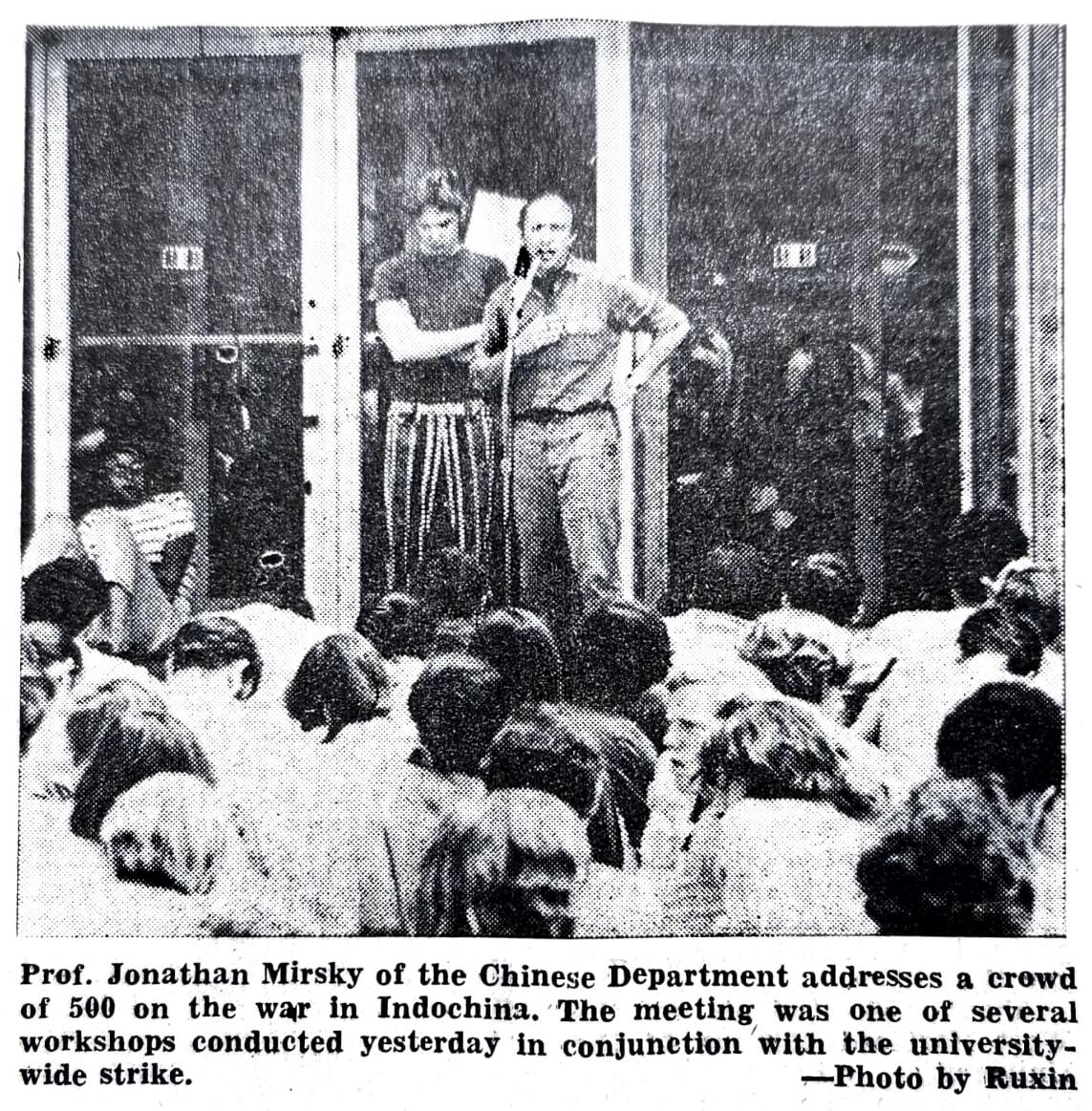
Photo of Professor Jonathan Mirsky in The Dartmouth leading a workshop on the Vietnam War during the 1970 strike.
These events, organized by both activist faculty and students, lasted throughout the term even as the week of cancelled classes ended.
Kloppenberg, now a Professor of History at Harvard University, reflects on how the 1970 “Cambodia Spring” shaped his emerging worldview as a freshman:
“And so that spring, the spring of 1970, was really in some ways the turning point of my life, and it was the anti-war activities at Dartmouth that were responsible for that change.”
— James Kloppenberg ‘73
Courses and the Vietnam War: Separate or Inseparable?
Roll the “atrocities”
The faculty’s dedication to offering an alternative education did not stop at the spring of 1970. Beyond individual teach-ins, professors in the History Department routinely raised the relevance of the Vietnam issue and current events in the courses they taught.

Professor Eisenberg stands on a podium in a Dartmouth classroom.
Most notoriously, in her 2025 oral history, Professor Eissenberg recalls teaching a course that students’ nicknamed “atrocities”:
*“My Lai” references the My Lai massacre of March 16, 1968, when U.S. troops entered the Vietnamese village of My Lai to, purportedly, combat residing Viet Cong forces. Despite not encountering any adversary troops, the soldiers opened fire and murdered over 300 civilians.
Professor Eisenberg’s reference to the “official” truth as contrasted to “bad news” demonstrates how state-sanctioned educational materials were deeply infused with propaganda at the time. Bringing up My Lai, which occurred only three years before Dr. Eisenberg arrived at Dartmouth, was an important act of dissent against the Nixon administration’s actions. Before the massacre was exposed by a journalist twenty long months later, the Army expended a significant amount of resources attempting to cover it up.

Clipping of the Dartmouth Office of Information Services' report evaluating the performance of Professor Carolyn Eisenberg's courses.
Even the College took note of Professor Eisenberg’s provocative teaching style. According to a report issued by the Dartmouth Office of Information Services, when “the topic of Carolyn (Rusty) Eisenberg comes up, controversy usually dominates the conversation.” The “political situation in Southeast Asia” apparently “took its toll” on Professor Eisenberg’s courses, labeled by the Office as “Vietnam bull-sessions.” At the same time, Professor Eisenberg was not alone in bringing “atrocities” to the classroom. She continues in her oral history:
Her description of these young faculty as a “cadre” conveys the intimate sense of camaraderie they shared amongst themselves. Together, these faculty sought to disrupt the norm of treating education as categorically separate from political discussion.
Pushing the envelope of “academic freedom”
One member of this cadre was certainly Professor Mirsky, who, according to Professor Marysa Navarro’s oral history, taught one of the only courses in the college curriculum on the Vietnam War during this time.
In 1975, when the College refused to offer Professor Mirsky tenure, many conjectured that the College’s denial was a result of his antiwar praxis. On May 19, two students wrote in The Dartmouth analyzing the causes of his departure. Citing evidence of favorable reports from the evaluation committee and the History Department, along with Professor Mirsky’s outstanding record of publications, the students were left only one explanation:

Clipping of "Did Jonathan Mirsky Quit Or Was He Thrown Out?" in The Dartmouth. May 19, 1975.
As the College debated the merits of Professor Mirsky’s tenure, dozens students and faculty wrote letters to the Dean demanding that Dartmouth honor its ideal of “academic freedom.” One of Professor Mirsky’s students, Tara R. Mullen, wrote:
Beyond his particular case for tenure, Professor Mirsky’s controversial teaching style triggered broader discussions surrounding Dartmouth’s endorsed principles and values. What was the responsibility of the College in confronting the global atrocities of its time? Was the College’s emphasis on “objectivity” and “neutrality” in fact a hindrance to academic freedom?
Another of Professor Mirsky’s former students, Edwin E. Cummings ‘68, complemented Mullen’s reckoning of the College’s values as a scholarly institution:
“Can you imagine how dull a campus full of 'moderate Democrats and Republicans’ can be? For my money, let's have more Mirskys, Harts, Don Millers and Bill Linds.”
— Edwin E. Cunnings ‘68
Through both teach-ins and innovative course pedagogy, antiwar faculty challenged the separation between politics and the classroom during the Vietnam war period. Considering the experiences of their students, they broke the taboo on discussion of the Vietnam War in academic settings. Their openness for candid political discussion created space for for students to challenge and understand viewpoints beyond their own. Per the piles of letters written in support of Professor Mirsky's retention at Dartmouth, perhaps some “Vietnam bull-sessions” were just what the College needed.
"Preluding Moratorium, Teach-in Attracts Many"
Article in The Dartmouth titled "Preluding Moratorium, Teach-in Attracts Many" reporting on the May 5, 1970 teach-in.

"Kemeny Says 'Soul Searching' To Replace Regular Classes"
Article in The Dartmouth reporting Kemeny's announcement of a week of cancelled classes on May 5, 1970.

"Strike Schedule"
"Strike Schedule" published in The Dartmouth on May 6, 1970, listing the day's arranged programming during the student strike.
"Did Jonathan Mirsky Quit Or Was He Thrown Out?"
Article in The Dartmouth assessing the causes of Professor Mirksy's departure from Dartmouth. May 19, 1975.