
Operation Lam Son 719: A Window into the Failure of Vietnamization

Richard Nixon's presidential speech announcing the implementation of Vietnamization. The White House, November 1969
By 1969, the Nixon administration—realizing that public support for the Vietnam War in the United States was evaporating—had begun to withdraw U.S. forces from Vietnam. In order to counterbalance the departing U.S. troops, the Nixon administration implemented the policy of "Vietnamization," which attempted to gradually transfer the responsibility of fighting from the U.S. to the South Vietnamese—specifically, the Army of the Republic of Vietnam (ARVN).
According to this policy, the U.S. would provide equipment and training to the ARVN and ultimately make them self-sufficient. In theory, the increased fighting capacity of the ARVN would ensure that the U.S. troops could leave without the threat of a communist takeover in their absence. Almost overnight, Vietnamization became a major part of U.S. military operations in Vietnam. The U.S. military began to ramp up its training of the South Vietnamese Armed Forces, the RVNAF, as well as passing more equippment to the South Vietnamese in the hopes that they would use it for the war effort. U.S. military strategists also began planning ways in which to utilize the RVNAF so that they could gain experience fighting as a standalone military.
Military advisors would play a large role in this Vietnamization effort. The MACV (Military Assistance Command, Vietnam), an organization tasked with overseeing the U.S. advisory effort in Vietnam, became instrumental in the United States’ efforts to improve the military capacity of the South Vietnamese military. American advisors, under the MACV, would train Vietnamese soldiers as well as provide combat assistance. U.S. advisors would be crucial to Vietnamese forces on the ground, giving Vietnamese soldiers instructions under fire as well as working the radio to call in air support, medivacs, and resupplies.
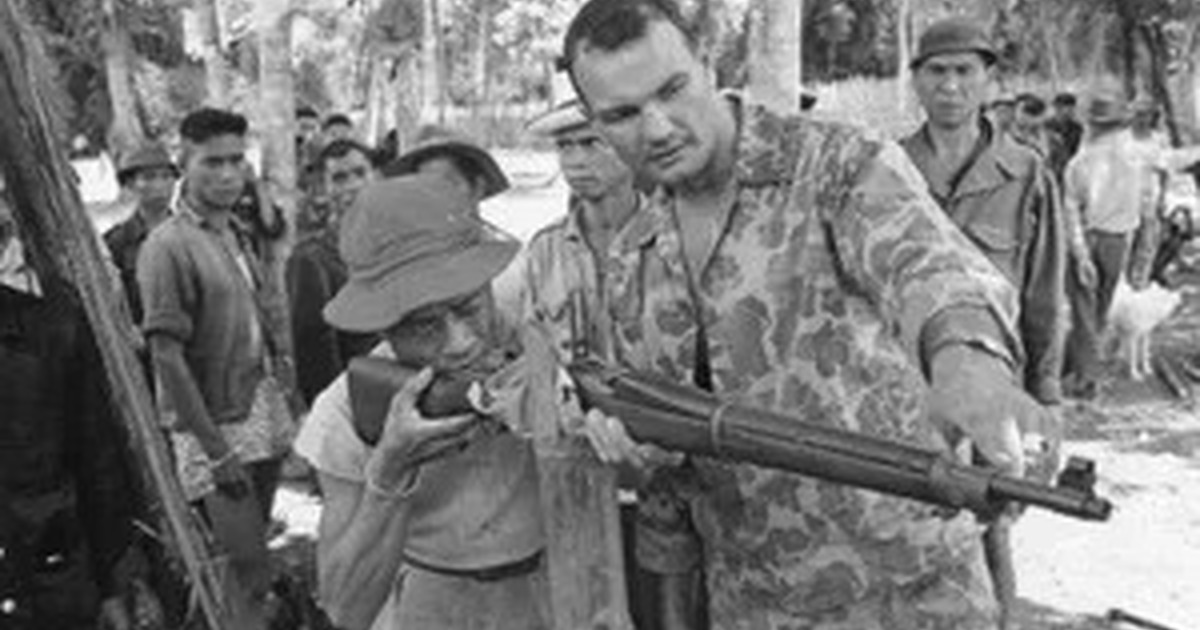
U.S. advisor training Montagnards (indigenous central highlanders) at a fortified camp near Buon Me Thuot in central Vietnam, July 1962
MACV advisors often formed close bonds with the Vietnamese soldiers under their command. Major David Wiseman, who advised the 2nd Battalion, 2nd Regiment, formed close bonds with its commander, Tran Ngoc Hue—or “Harry,” as Wiseman and other Americans often called him. Wiseman recalls, “When we had our one week back from the field, Harry would always drag me home with him. I used to try to talk to his mother. She taught me how to chew betel nut, which caused a rush through your upper body that made it hard to raise your arms. One of the happiest things I was able to do was to get an old Navy friend...to send me a Japanese three-burner cooking stove that ran off propane for his mom.”
The success of the ARVN on Hamburger Hill during the Tet Offensive, as well as their success during the Cambodian Incursion, gave the Nixon administration great confidence in the ARVN’s ability. Thanks to the tactical success of the Cambodian Incursion, which curtailed People's Army of Vietnam (PAVN) operations in the region, the PAVN became more dependent on routes of the Ho Chi Minh Trail through Laos. At the urging of the Nixon administration, the ARVN conducted their own incursion into Laos in order to target the Laotian portions of the Ho Chi Minh Trail. If successful, this operation—codenamed Lam Son 719—would cripple North Vietnamese logistical efforts and, more importantly, show the competency of the South Vietnamese military and the effectiveness of the U.S. Vietnamization effort.
Understanding operation Lam Son 719 and the reasons behind its eventual failure gives us crucial insight into the greater issues of Vietnamization.
Click these links to access the exhibit pages: